
April: Singing in Spring
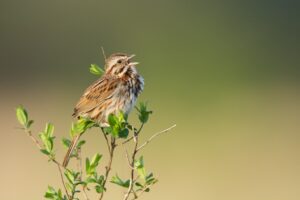
Birdsong has long held a special place in the culture and lives of humans, inspiring philosophers, artists, and scientists alike. After long months of cold, quiet, and dormancy of life, their return signals warmer, brighter days ahead, and their songs have come to represent hope, renewal, and peace.
Human relationship with birdsong goes beyond the artistic and philosophical. It is also physical – literally in our genes. When we hear birds singing, we may feel a sense of peace, contentment, and relaxation. This is more than just an appreciation for nature’s finest musicians – it is an evolutionary response. Birds sing when they feel their surroundings are free of danger. Humans have evolved to recognize birdsong as a signal of safety, and we respond accordingly, even without our realizing. Our bodies shift into the parasympathetic nervous system when we hear birdsong – our heartbeats slow, muscles relax, and we feel more at ease and balanced. Studies have found listening to birdsong can help reduce stress, anxiety, depressive symptoms, and can even help individuals achieve a deeper concentration.
April is a time of peak birdsong activity. The first full month of spring, songbird vocalizations are in full swing, especially in the morning hours. As migrating songbirds return and breeding season begins, birds are singing to establish and defend territory, as well as attract mates.
There are other possibilities as to why birds sing – some of which are lacking in research due to longstanding bias towards male songbirds in the scientific community. For a long time, female songbirds were excluded from research with the assumption that they didn’t sing. In fact, if a female bird was observed singing, it was dismissed as an irregular behavior, due to a hormone imbalance or some other anomalous factor.
This bias in scientific research has created a widespread misunderstanding that male songbirds are the only ones to sing. However, more recent research has upended this misconception, and estimates that female songs occur among two-thirds of songbird species. A comprehensive understanding of female songs requires further research, but it is thought females sing for reasons including territory defense, female competition, intra-pair communication, and even parent-offspring communication. This indicates female songs are an innate and key part of the social functioning of the bird world.
In the chorus of our feathered friends, there’s so much to be heard. This spring, tune in to the warblers, sparrows, finches and wrens. You’ll hear chatters of family drama, melodies of romantic pursuits, trills of property disputes – and even get a mental boost out of it!
Author – Emma Kelsey, Intern/Teacher Naturalist
2026 Nature Notes
January – How Does One of the Smallest Birds Survive Minnesota Winters?
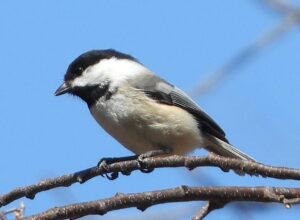
Black-capped chickadees may be one of the most easily recognizable birds both by their look and by their call: “chicka-dee-dee-dee”. However, did you know that chickadees are one of the smallest and hardiest birds that stays and faces Minnesota winters head on? Most people think about birds migrating south, moving to warmer locations, and living through the winter season in these areas. Have you ever considered how such a tiny bird like the chickadee manages to survive our harsh Minnesota winters?
One of my favorite classes to teach was about birds in the winter, specifically chickadees. Chickadees have some impressive adaptations to survive our cold Minnesota winter months. One of the chickadees adaptations is their memory. To demonstrate this to the students, we would take a handful of sunflower seeds and hide them outside before going on a birding hike, then we would have to come back 2 hours later and try to find all the seeds we hid. This activity opened the students’ eyes to how amazing chickadees memories are, because most of the students could not remember where they hid their seeds. Chickadees start to stash food in autumn to go back to on cold and short days. Having extra stashes of food around is necessary for these birds since they are burning so much energy every day in order to keep their body temperature around 108 degrees Fahrenheit. Of course, their half-inch coat of insulating feathers helps keep them warm. They fluff those feathers up at night to fill every inch of their roost cavities to keep out as much wind as possible. The most amazing adaptation is the fact that they have the ability to go into regulated hypothermia, which enables them to lower their body temperature about 12 to 15 degrees Fahrenheit. This allows them to conserve their fat storage and survive some of the coldest nights. Another great way to stay warm is to share a roost cavity and body heat with a fellow chickadee!
They flock together and hang out in the same place forming a social group of 6-10 birds during the daytime in the winter. One could see these social groups that chickadees form around feeders; sometimes nuthatches and downy woodpeckers will join these social groups which are called flocks. These flocks defend a territory of up to 20 acres and you can usually hear territory skirmishes surrounding the feeders. Listen for a “dee-dee” alarm sound when chickadees are defending their territory. There are many different communication sounds going on at your feeders, so get out there and listen!
Author: Sydney Weisinger – Teacher/Naturalist
February – Sundogs, Pillars, and Halos, Oh My!
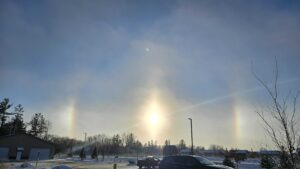
The atmosphere can create beautiful colorful displays when the conditions are just right. Some of these displays are sundogs, pillars, and halos. To understand how they are created, we have to talk about light.
Light is electromagnetic radiation with a wavelength that is visible to the eye. Visible light is composed of all colors of the rainbow: a range from darkest red to deepest violet. The way we can see this is by using a prism to break apart visible light into component colors. So, in the atmosphere, under certain conditions, water drops and ice crystals function as a prism, allowing us to see assorted colors. To deepen this understanding, we can talk about the difference between refraction and reflection. Refraction is the change in direction of a light wave due to a change in speed. When a light is refracted inside an ice crystal or water droplet, it is broken into its component colors, or the rainbow effect. Reflection is when the wave encounters a surface that does not absorb the energy of the radiation and bounces the waves away from the surface. This means the light does not get broken into component colors, instead reflected at equal angles.
Now we can look at the difference between a sundog, sun pillar, and halos. Sundogs are colored spots of light that develop due to the refraction of light through ice crystals. These can be spotted about 22 degrees from the left, right, or both sides of the sun, all depending on where the ice crystals are present. The colors we will see go from red (closest to sun) to blue (outside of the sundog). They get the nickname of mock suns or Parahelia, which means “with the sun., because it can sometimes look like multiple suns in the sky.
The next one is sun pillars. Sun Pillars appear as a shaft of light extends vertically above the sun. These commonly occur at sunrise or sunset. Sometimes sun pillars can also be seen with city lights as they create vertical beams in the night sky. They will form when ice crystals are falling through the air, reflecting the sun’s rays off them.
The last one being halos. Halos are a ring or light that form around the sun or moon. The light will refract off ice crystals present in a thin veil of cirrus clouds. Most commonly seen as bright, white rings, which is how they receive their name, but can occasionally have color. They can be seen with a 44-degree diameter, appearing largely in our sky. The winter months are the best time to see sundogs, pillars, and halos, so make sure to take chances to look up. The conditions may be just right to witness a beautiful illusion and you can explain to others how this phenomenon works.
Author: Emily Hagen – Intern Teacher/Naturalist
March – Spongy Moth: A New Danger Approaches
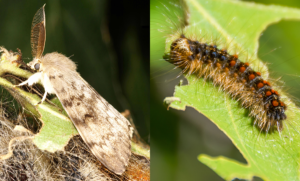
A new woodland danger is on the horizon, in the form of an insect… again. As opposed to a threat like the emerald ash borer that swept through the town of Austin and killed off most of our Ash trees, the spongy moth could be even more devastating. While oak trees might be the favorite snack, there is a whopping list of over 300 species of trees and shrubs that this moth can eat the leaves of, which means a lot more widespread damage.
Originally from across the Atlantic in Europe, northern Africa, and parts of Asia, the spongy moth is an invasive species introduced to North America back in the late 1800s. The dispersal of these pests is fortunately slow since the female moths cannot fly, but the spread has continued to this day from the New England area towards the Midwest.
When the spongy moth wreaks havoc, it is their caterpillars that do the most damage, not the adult moths. After these larvae emerge from their hidden egg masses after 10 months, they have quite an appetite. These very hungry caterpillars can defoliate an entire forest if the population is left unchecked.
However, everyone knows that a tree without leaves doesn’t die, as most of our trees lose their leaves every fall anyways, so what is the real issue? The biggest thing is the timing of the defoliation. The leaves are being eaten in the summer when these broad leaf plants are in their peak greenery. The green leaves signal a huge food making production thanks to photosynthesis where the plants make their own food from sunlight, carbon dioxide, and water. If these trees do not have their leaves, they cannot make their own food. Usually, trees have some food stores they can utilize in certain cases, but the fact that production ceases can cause the tree to weaken. Think of losing all the leaves during mid-growing season as weakening the trees’ immune system. Making them more susceptible to a plethora of other pests and diseases that would not have been an issue before.
The large range of species of trees the spongy moth caterpillars can eat can cause the downfall of entire forests, both wild and urban. The bad news is that there have been some adult males located within Mower County. The good news is, there is a solution. The Minnesota DNR has their finger on the pulse of this growing invasive species concern, with a plan in place to save our trees. They will be having an information meeting in early April to discuss a management plan for our area. Interested parties should visit https://www.mda.state.mn.us/smmanagement
Author: Kelly Bahl – Outreach Teacher/Naturalist
2025 Nature Notes
December – Aurora Borealis
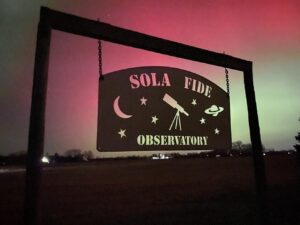
A few weeks ago, I found myself gazing at the night sky, parked on the edge of a cornfield in my flannel pajamas. It’s not every day that something so extraordinary and urgent comes along that I leave the house in my slippers; but a picture-perfect aurora borealis is just that. As the greens and pinks danced in the sky, I knew that whatever was happening up there felt almost like magic. Turns out, it’s all thanks to the sun.
The Aurora Borealis, or the Northern Lights, are the result of particles emitted from the sun mingling with the magnetic field of the Earth. As these charged particles collide with electrons in the magnetic field, photons (or light particles) are emitted, leading to aurorae. After looking into this phenomenon a bit more, I’m glad I didn’t waste any time heading out the door; auroras often come with little warning and a short window of time to watch. There really is no way of definitively predicting them, though a clear night sky, checking in on the geomagnetic activity index, and satellite measurements of solar wind can give us a better chance.
“Aurora” is named after the Roman Goddess of dawn, and “Borealis” comes from the Greek word for wind, boreas. While aurorae today are cause for great joy and awe, they were often feared before they were understood. Some cultures associate the Northern Lights with bad omens like the Sami indigenous people of Norway and the Inuit people of Northwestern Canada. However, in the Anishinaabe Ojibwe culture, the lights remind them of those that they have lost. Their relatives spend the night dancing in the sky, exchanging who leads with each night. There are some nights that individuals feel a connection knowing that their relative or loved one is the one leading the dance that evening. The Finish call auroras “Revontulet” which directly translates to fox fire; there is an ancient Finnish story about mythical fire foxes whose tails create green and red “sparks” as they drag on rocks, tree branches, and uneven terrain as they run through the landscape.
As auroras are the result of our magnetic field interacting with the sun’s emitted ions, there are certain latitudes that have a higher chance of seeing auroras; in fact, NOAA states that there is a 50% or greater chance of seeing auroras between the latitudes of 55- and 80-degrees North on any given day. However, cloud cover and amount of daylight greatly impact visibility, so winter is often the best time to see them. If the magnetic field and solar wind align, don’t let mismatched pajamas stop you from hopping in the car to catch them!
Author: Meredith Maloney – Office Manager/Naturalist
November – Where Do Bald Eagles Migrate to In the Winter?
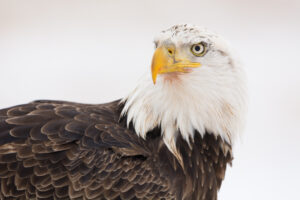
As fall and winter approach, we are seeing an increase in bird migration. Many of these birds are going to warmer areas, like Arizona, Texas, Mississippi, etc. But did you know that Minnesota is another popular location for birds to spend the wintertime, especially for one common raptor.
Although we may see Bald Eagles all year round in Minnesota, their population increases during wintertime. Many Bald Eagles breed in Canada from March to November, before the colder temperatures begin. Then their migration to Minnesota begins in early November, while best viewing of them is from December to March. During this time, they use the Mississippi River valley as a corridor to get to southeastern Minnesota. A popular viewing area is near the Red Wing and Wabasha area, where the Chippewa River remains open for the winter. These open waters attract other waterfowls and fish that the Bald Eagles can feast on. But you might also find Bald Eagles near the roads scavenging on animal carcasses or hunting in fields.
Bald Eagles tend to migrate in groups called a stream. The stream can be 20 to 30 miles long and spread about half a mile apart. While they are migrating, they can fly as many as 225 miles a day but average 98 miles per day. And they fly an average of 30 miles per hour during the day. Bald Eagles depend on the wind to travel longer distances for migration. So, if there is no wind, they cannot soar and must stay put.
Last March, the National Eagle Center announced their winter eagle count with a total of 3,974 spotted from January to March. The center did express some concern with a lower count than normal due to the warmer climate. Since we are having milder winters, the Mississippi River has not frozen over as much as in previous years. This has caused changes in the Bald Eagles’ behaviors to congregate in the historical hot spots for their watches. The change in weather means that Bald Eagles and other birds do not have to migrate as far as they usually do to get the food they need. As well as allowing them to return to their breeding grounds earlier if the weather and food availability permit.
Next time you are at the Nature Center, make sure to check for any soaring Bald Eagles above our pond and stream. We see lots as we walk around and hopefully you can too!
Author: Emily Hagen – Intern Teacher/Naturalist
October – Sometimes You Feel Like a Nut
Minnesota boasts incredible coniferous and hardwood forests in the northern part of the state as well as plenty of deciduous forests in the south. In amongst the deciduous forests, lay hidden gems that are a feast for the eyes, and the stomachs.
There are quite a few species of trees that produce a seed that can be enjoyed not only by the woodland creatures that reside in the woods, but us human folk too. The trees in question can be lumped into the tasty snack category of tree nuts. However, there are quite a few nuts we think of that are not nuts at all, but no less delicious.
Some of the most popular native trees with edible nuts are Black Walnut: Juglans nigra, Butternut: Juglans cinerea, American Hazelnut: Corylus americana, andShagbark Hickory: Carya ovata. Of these only the hazelnut is a true nut. Everything else is considered a drupe.
To establish the difference between a nut and drupe, a classification of how the part of the plant that is being eaten as a nut grows and develops needs to be determined. The definition of a true tree nut has a hard shell encasing the edible seed of a plant. Simple enough. Yet, if that hard shell that is encasing the edible seed is also surrounded by another layer, like fleshy fruit, then the edible seed is not a true tree nut, but a drupe instead.
It would be comparable to opening a stone fruit like a peach or a cherry but not utilizing the flesh of the fruit because it is not edible. Instead, discard the flesh and break open the pit to harvest the seeds inside. Now, the seeds inside of stone fruit are not edible, for they contain cyanide, but that is for a different article.
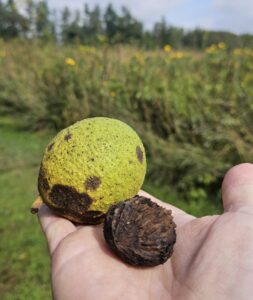
Think of the well-known black walnuts. They produce these tennis ball sized fruits that are green in color and fall to the ground with a resounding thunk. Peel that open, and find a deeply ridged shell enveloping the edible seed on the inside. The husk of the fruit is great as a natural dye, but not something that is considered edible. The black walnut has a bold floral, almost earthy flavor to it. It has been known to be more bitter than the English walnut counterpart but can be enjoyed raw or cooked.
The American hazelnut grows on more of a glorified bush, than tree, only reaching heights from six to twelve feet tall. This true tree nut is smaller than it’s European counterpart but has milder and sweeter flavor. Shagbark hickory trees have the shaggiest bark on a tree, making them easy to identify and their nut has a flavor reminiscent of a mix between a walnut and a pecan. Whereas the more elusive butternut has the least bitterness of any of our tree nuts with a light and buttery taste to it, hence the name.
These tree nuts have been nutrient dense delicacies that have been coveted, harvested, and enjoyed by people for thousands of years here in this area of the Midwest. While some might be true tree nuts, and other drupes, one thing is for certain, what they are called does not change the fact that they are an enjoyable snack. Maybe one that can be found in your own back yard.
Author: Kelly Bahl – Outreach Teacher/Naturalist
September – Chimney Swift
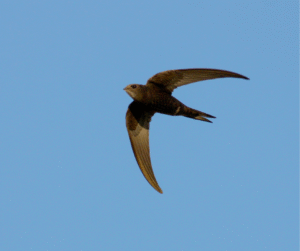
Every evening this summer, the sky above Main Street fills with small, fast moving birds darting and chirping above the buildings. While they are unnoticed by most, it only takes one look up to realize these are not ordinary birds. Nicknamed “flying cigars” because of their slender, tube-shaped bodies, their amazing speed and constant aerial acrobatics make them hard to miss once you know what to look for. These are Chimney Swifts, and while they have spent the last several months performing every night on Main Street and throughout town, by the end of September they will all be gone.
Chimney swifts arrived here in May, focused on finding mates, building nests, and raising their young. They time their yearly appearance with the emergence of insect populations so that they are sure to find an abundance of mosquitoes, flies, and gnats. Just one swift can eat hundreds of insects in a day, making them a valuable ally in controlling pest populations during the warm months. At the end of September, they will embark on their journey south, flying thousands of miles to South America, where they will spend their winter.
While most birds can be spotted sitting in bushes, on buildings, or even powerlines, the only way to see a Chimney Swift is in the air. They are almost entirely aerial, and eat, drink, bathe, and even gather nesting materials while flying. Due to their unique feet, chimney swifts are unable to land on flat surfaces like branches or wires. Although chimney swifts may be all around us, many people never realize they are here.
Their feet are small and adapted for clinging, rather than perching, because they evolved to nest in large, hollow trees. As forests were cleared and old trees disappeared, swifts adapted by using masonry chimneys built by people. For more than a century, this relationship worked well. However, chimney swifts are again facing a housing challenge. Most homes built today don’t have chimneys, and existing chimneys are being removed, capped, or lined with smooth materials that swifts cannot grip. As a result, nesting and roosting sites have declined dramatically. The North American Breeding Bird Survey estimates that swift populations have dropped by more than 70 percent in the past 50 years.
If you have a brick chimney, please consider leaving it open during the summer months to provide habitat. Their presence here is a reminder that our homes and actions are part of a much larger network, stretching from the Amazon to our Midwestern skies. By making space for them, we ensure that future generations can continue to look up on summer evenings, hearing their cheerful chatter and watching their incredible acrobatics.
Author: Avery Wickham
August – No-See-Ums: You can’t see um, so let’s talk about um
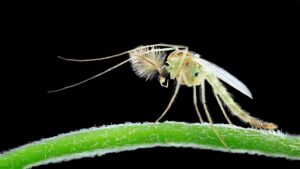
It’s time to understand these tiny, sly bugs that often result in breaking out the bug spray or heading back inside. No-see-ums, also referred to as sand gnats, biting midges, punkies, moose flies, five-o’s, and sandflies, are well known for being party poopers. But what are they, really?
No-see-ums are a common term for a very large family: Ceratopogonidae, which encompasses ~4,000 different species. The vast majority of species in this family don’t bother people and stick to feeding on other insects or animals; most are only hazardous when they fly up my nose while I’m on a bike ride.
No-see-ums, however, bite for blood; females will bite when in need of nutrients for egg production, and do so by cutting open the skin with an appendage that serves as a pair of tiny scissors. Afterwards, they release a chemical into the skin which prevents blood from clotting. Once this chemical is released, they drink blood through their proboscis, which is sort of like the tongue equivalent of a straw.
While your skin may be crawling at the thought, no-see-um bites are rarely more than an itchy inconvenience. They are not known to carry diseases to humans, and bites often go away within a matter of days. According to Miriam Webster, the term no-see-um’s first known use was in 1842, and was used by Native Americans to describe the pest. Their scientific name Ceratopogonidae comes from the Greek “Keratos”, which translates to “horns”, and “pogon”, which translates to “beard”. This is likely because of the fuzzy antennae that the males often have.
No-see-um females can lay up to 450 eggs at a time, and can lay eggs up to 7 times in their lives. Not all eggs survive, which is why so many are laid. Eggs often hatch within 10 days of being laid, and then go into their larval stage, as all insects do. During their larval stage, they undergo four growth periods called instars, and grow until they are ready to go into their adult phase. Their entire life cycle is often between 2 and 6 weeks, but varies based on species, environmental factors, and more.
So while they may pose a threat to your enjoyment of a backyard barbecue, remember that while they are undeniably annoying, their time is limited and they are a great food source for bats, birds, dragonflies, frogs, and some of our other favorite critters.
Author: Meredith Maloney, Office Manager/Naturalist
July – The Harbinger of Dog Days: The Dog-Day Cicada
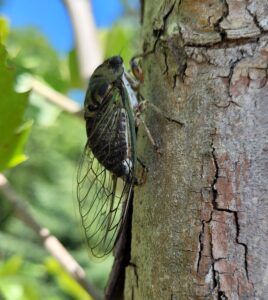
Quickly approaching are the “dog days” of summer – a period of some of the hottest days, typically around the second half of July. While most of us are trying to beat the heat, our cicadas emerge to sing the one and only song of their lives.
In the past year on the news, there’s been a lot of talk about the “double brood” emergence of 13- and 17-year periodical cicadas, causing the appearance of more cicadas than usual. We don’t have these periodical cicadas here in Minnesota – instead, we have annual cicadas that we see every year!
Despite their name, annual cicadas can live for more than a year – their average lifespan is about two to five years. They start as nymphs underground, where they primarily feast on pine and oak sap from roots. This can cause occasional issues in younger trees and shrubs, but more mature trees can tolerate the damage
After spending several years in their nymph stage, they’re ready for adulthood! This is the stage where most of us see cicadas in. They tend to emerge when the average soil temperature reaches over 60 degrees Fahrenheit, which averages to mid-July. They climb to the top of the tree canopy to search for a mate. They utilize a special organ, called a tymbal, that helps them sing that buzzy song we all know and love.
A cicada only spends three to four weeks in this adult stage, singing from the treetops. This time is a mad rush to mate and lay eggs before dying. These eggs hatch 6-10 weeks after being laid, where the nymphs fall back to the soil and begin to burrow underground in search of food. With time, they’ll be ready to sing us songs of future summers.
Author: Katherine Schramek – Naturalist Intern
June – The Buzz About Native Flowers
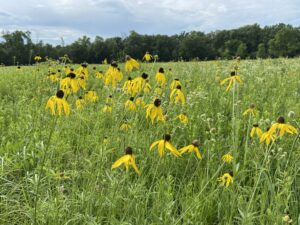
There has been a lot of buzz about the decline of bee populations lately. But what most people are focusing on is the loss of large honeybee colonies. While devasting, honeybees are actually not native to the United States and there are a greater diversity of pollinators that are being lost that we should be focusing on. One of the best ways to help our native Minnesota pollinators is to plant native Minnesota plants.
Besides honeybees, there are more than 500 native bee species to Minnesota alone. Other pollinators include butterflies, moths, beetles, and native flies. These pollinators play a large role in pollinating crops and native plants. A large contribution to their decline has been habitat loss and nutrition loss. Programs such as Lawns to Legumes aim to provide resources and funds to homeowners to create their own pollinator garden in their yard. The hope is that the more people who participate in these types of programs, the more pockets of habitat will be available for pollinators. Currently, most houses boast a large lawn with generally the same shrubs and non-native flowering landscape. This creates a mono-culture habitat that is not conducive to our native pollinators.
Planting native means you are providing appropriate nutrients for pollinators. Native plants and pollinators have evolved alongside one another. Some native plants have evolved specifically for certain pollinators, meaning they are shaped in such a way that only that pollinator can access its nectar. Therefore, for these native plants to continue to survive they rely on these pollinators having a healthy population. While other pollinators have evolved to rely on specific plants for their nectar and pollen needs. If native wildflowers become out competed by non-native flowers or these flowers are far and few between, those pollinators will struggle to get enough food and nutrients to reproduce, which leads to a fall in population.
One of the most important factors to focus on when starting your pollinator garden is making sure that you have a variety of plants that bloom early spring, summer, and late summer/into fall. This ensures that pollinators have a food source during the entire season they are out. Pollinators have different nutrient needs during spring, summer, and fall. Native flowers have evolved to bloom during different parts of the growing season to provide different ratios of nutrients and sugars to pollinators. For example, in spring, pollinators need high protein to build their population and raise young. Summer brings the need for more nectar and high energy for foraging and honey production. Whereas in autumn, pollinators focus less on pollen and more on the carbohydrates they get from nectar for overwintering. There is still time to get out there and plant your very own pollinator garden. The best way to start your garden is with plant plugs but you can also start by seed. Once established, native pollinator gardens need very little maintenance. Over the years, once the plants have become established, they will start to fill out and fill the area of your garden with wonderful color! Once fall hits, make sure to leave your garden alone until after the last frost in spring. This ensures that pollinators have ample habitat to overwinter in.
Author: Sydney Weisinger, Teacher/Naturalist
May – Dutchman’s Breeches: Funny Clothing, or Dainty Flowers?
May is the perfect time to explore surrounding woodlands for a plethora of flowers that can be only found for a couple of weeks in the early springtime. These flowers are called spring ephemerals, meaning they only last for a very short period. Spring ephemerals are racing against the clock of the canopy of trees making leaves and blocking out much needed sunlight. Which is why there is a massive bloom of flowers in forests before the trees leaf out.
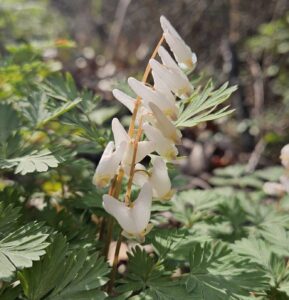
There are so many different varieties of spring blooms out there of various sizes, colors, and flower shapes but one super unique flower is Dicentra cucullaria, or Dutchman’s Breeches. In the bleeding-heart family, Dutchman’s Breeches receives its name from the funny shape of the flowers that look like pairs of pantaloons hanging on a clothesline. The flower petals fuse together making access to the flower’s nectar tricky to access. Luckily, there is a native insect that can pollinate and reach the nectar just fine. Queen bumblebees which are the only bumblebees that overwinter, emerge in early spring and are on the hunt for plenty of food before they start their own little hives. If you see a humungous bumblebee flitting around, it is probably a queen. They have a long tongue that is the perfect size and length to reach in the dutchman’s breeches funny shaped flowers to reach the nectar inside.
Dutchman’s Breeches have a fern-like leaf pattern and a stalk of 3-10 “pantaloon” flowers that reach a height of up to 12 inches. The pantaloon is comprised of two triangle petals fused together. The flowers and leaves start to bud underneath the soil to be ready to go once temperatures start to warm up. It springs up fast and flowers for a couple of weeks before they disappear once more.
The seed pods this plant makes have a coating that ants have deem delicious. Ants will carry the seeds to their nest, where they will eat the outer part of the seed and then that seed will root in the rich soil of the ant hill, far away from where it began. A symbiotic relationship for seed dispersal. Be sure to check out your nearest forested area for these blooms before they’re gone for the year.
Author: Kelly Bahl – Outreach Teacher/Naturalist
April – The Secret World of Vernal Pools
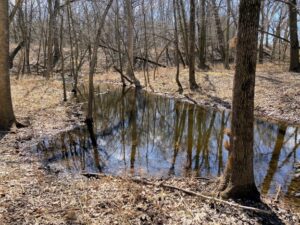
As winter melts away, keep your head down and try to spot one of these spring surprises on our trails. Melted snow and rain will collect in low spots on the ground forming temporary ponds, called vernal pools. While these puddles may look small, their short existence makes a large impact on the many animals that depend on them to survive, such as insects, frogs, salamanders, and more.
Unlike lakes or ponds, these pools will be gone and dried up by the time summer rolls around, which means fish can’t live in them. This makes them perfect homes for animals such as frogs and salamanders, because they don’t have to worry about fish eating their eggs or babies. Vernal pools can be found in forests, fields, and even near rivers, but how long they last depends on the weather. A very rainy spring might keep them around for a few months, but a dry season could make them disappear in just a few weeks.
Some of the most important animals in vernal pools are amphibians, who only live in water in the beginning of their lifecycle. These temporary puddles are the ideal habitat for eggs and young larva, who will be ready to transition to land in a few short weeks. That’s why vernal pools are perfect for them, a predator-free rental property!
One of the first frogs to wake up in the spring and utilize a vernal pool is the wood frog. These frogs do something amazing in the winter…they freeze solid! Their hearts stop beating, and they don’t move at all. But when the weather warms up, they thaw out and come back to life. In early spring, you might hear their funny “quacking” calls as they look for mates.
Another visitor to vernal pools is the Tiger salamander. In the spring, they crawl out on rainy nights and travel to vernal pools to lay their eggs. They are very loyal to their birthplace, and will travel long distances to return to the same puddle they were laid in. These secretive animals spend most of their lives underground, so people don’t see them very often, unless you stop into the nature center and see our two tiger salamanders inside of their enclosure.
Vernal pools don’t just help frogs and salamanders. Many tiny creatures live there too, like dragonflies and mosquitoes, who use vernal pools to lay their eggs. When the insects emerge, they become food for birds, fish, and other animals.
Even though vernal pools are important, they are often in danger. Since they disappear in the summer, people sometimes don’t realize they are special habitats. Construction, farming, and pollution can destroy them, making it harder for frogs, salamanders, and other animals to survive.
Vernal pools may not last forever, but they play a big role in nature. They give smaller animals a safe place to lay their eggs, provide food for many animals, and help keep the ecosystem in balance. If you ever find one in the woods, take a closer life and you might see some amazing creatures getting ready for spring!
Author: Avery Wickham – Intern Teacher/Naturalist